Interactive historical camera
Annum
Photography since 1839, in your pocket.
35 cameras, 1839 to 2010. Lift the lens cap, line up the rangefinder, turn the crank: work each camera the way its owner did and get the photograph it would have made.
Coming soon to the App Store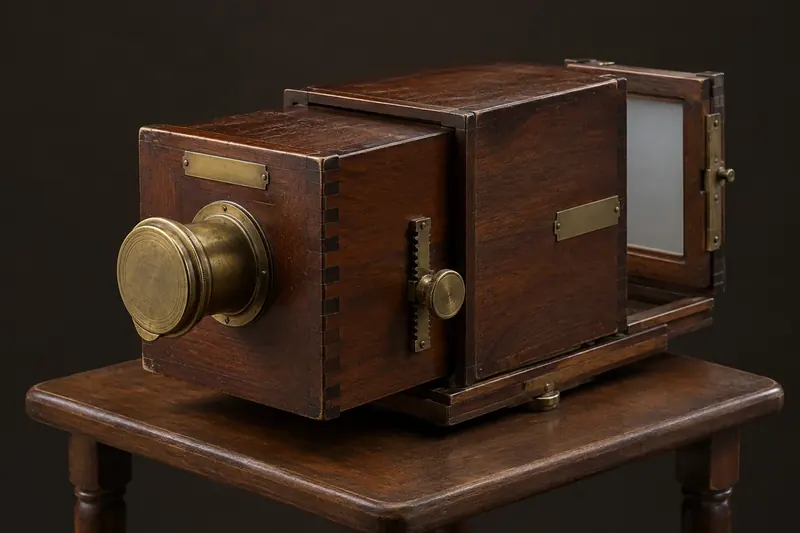
- 35 camerasFrom 1839 to 2010
- Each era’s own controlsPlates, cranks, rangefinders
- A historically informed lookLight sensitivity, lens, grain, paper
- Made for iPhoneDeveloped on your device
- A history page per cameraLearn while you shoot
Explore the cameras
From daguerreotype to digicam
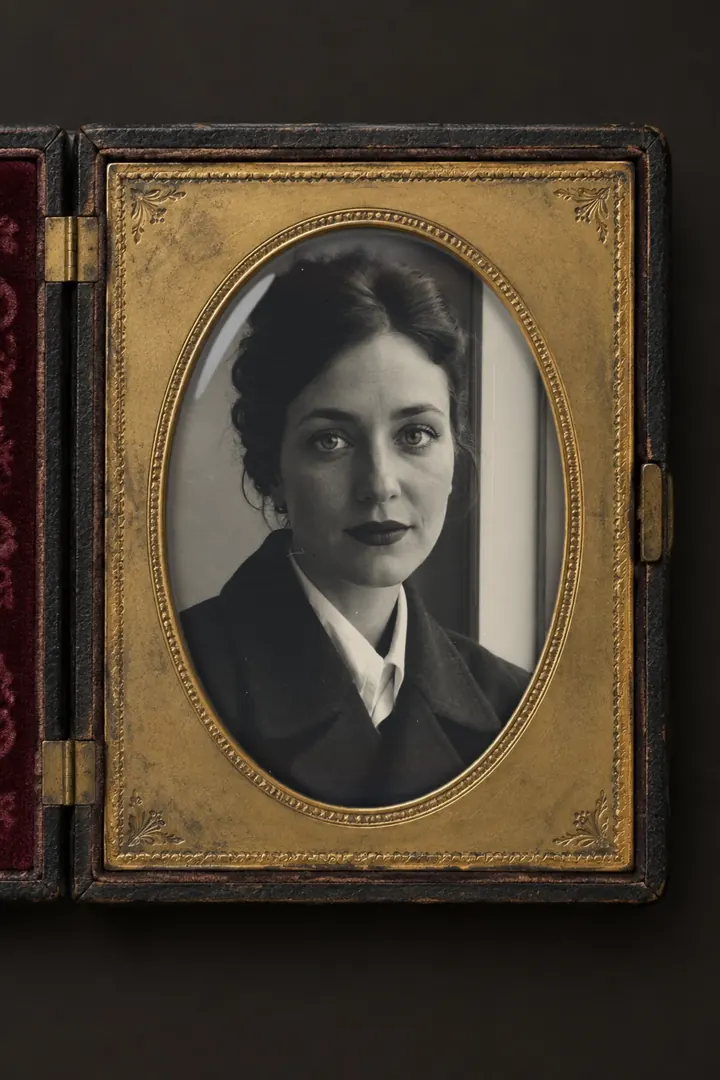
- Daguerreotype 1839
-
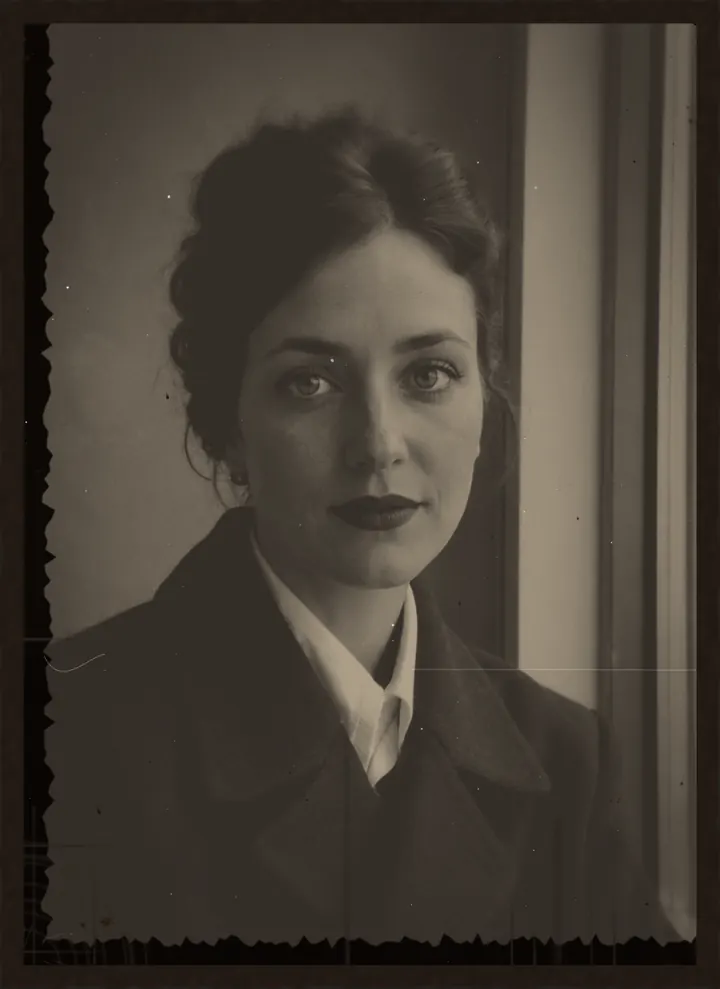 Tintype 1856
 -
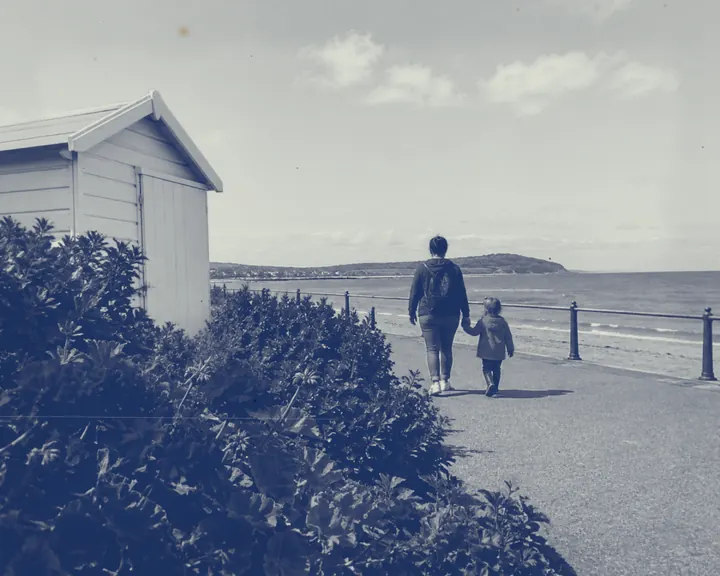 Cyanotype 1842
 -
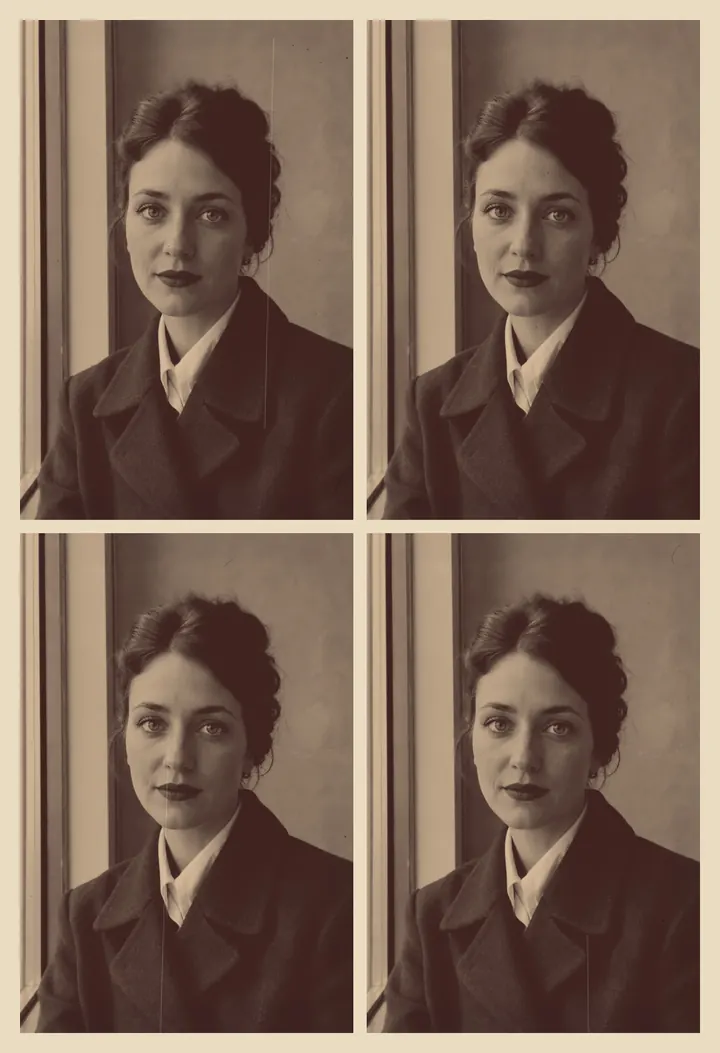 Carte de visite 1864
 -
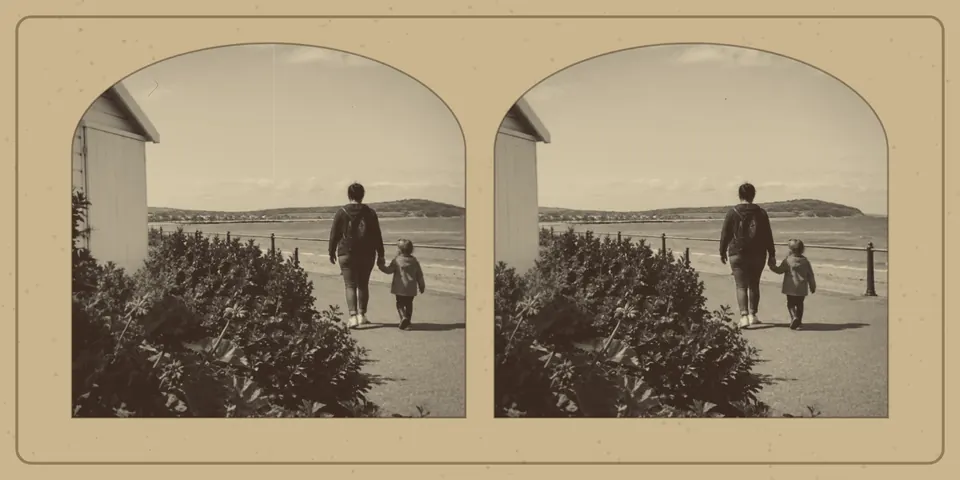 Stereo camera 1898
 -
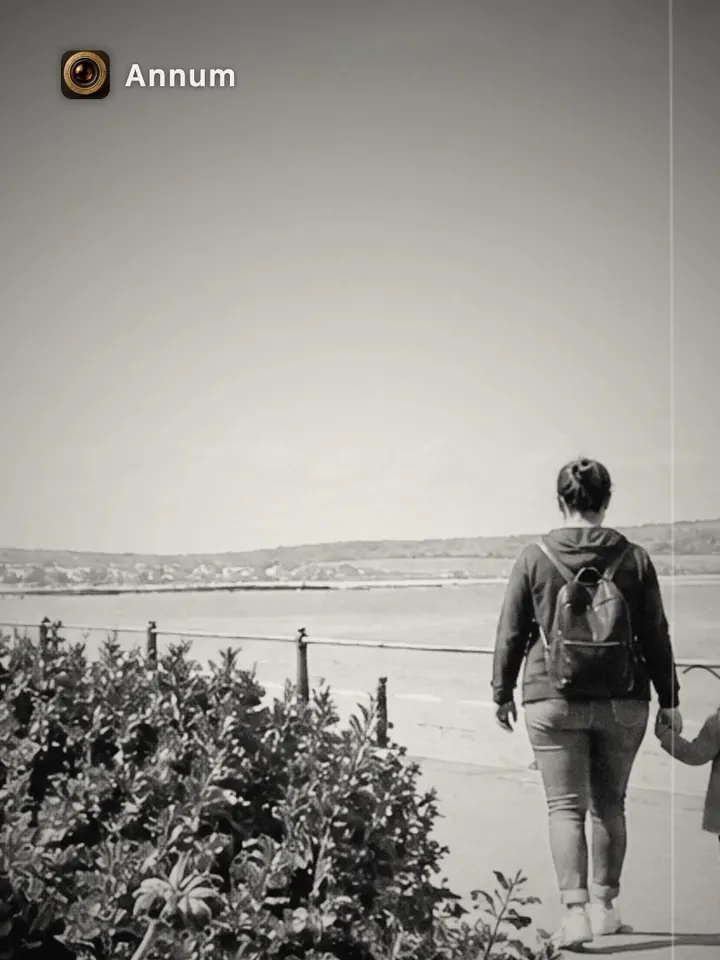 Silent film 1925
 -
 Instant film 1972
 -
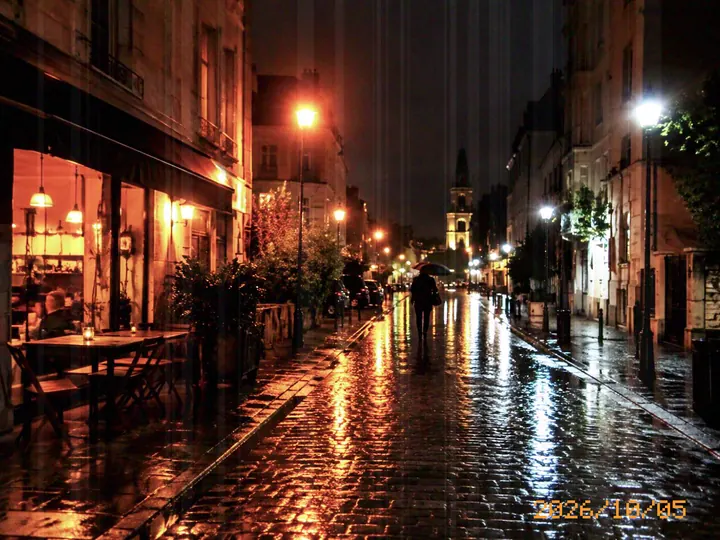 CCD digicam 2003
Examples made with Annum, developed by the app from one set of photos. The demo photos are AI-generated; every plate, print and file on this page was developed in Annum.
All 35 cameras, by year
Three are free forever: Tintype, Classic 35 mm B&W and Disposable. Every other camera gives 3 free shots before you decide.
- 1839 Daguerreotype Silver-plated copper, mercury-developed
- 1841 Calotype Paper negative, salt print
- 1842 Cyanotype Iron salts printed in sunlight
- 1854 Ambrotype Wet collodion on glass
- 1856 TintypeFree Wet collodion on lacquered iron
- 1864 Carte de visite Multi-lens camera, albumen print
- 1870 Albumen cabinet card Albumen print on a card mount
- 1898 Stereo camera Glass plates, stereo pair
- 1899 Swing-lens panorama Roll film, rotating lens
- 1900 Box camera Orthochromatic roll film
- 1907 Autochrome Colour screen glass plate
- 1920 Hand-tinted portrait Gelatin silver print, painted by hand
- 1925 Silent film Hand-cranked 35 mm orthochromatic film
- 1926 Folding camera 120 roll film, bellows and leaf shutter
- 1927 Photo booth Direct-positive paper strip
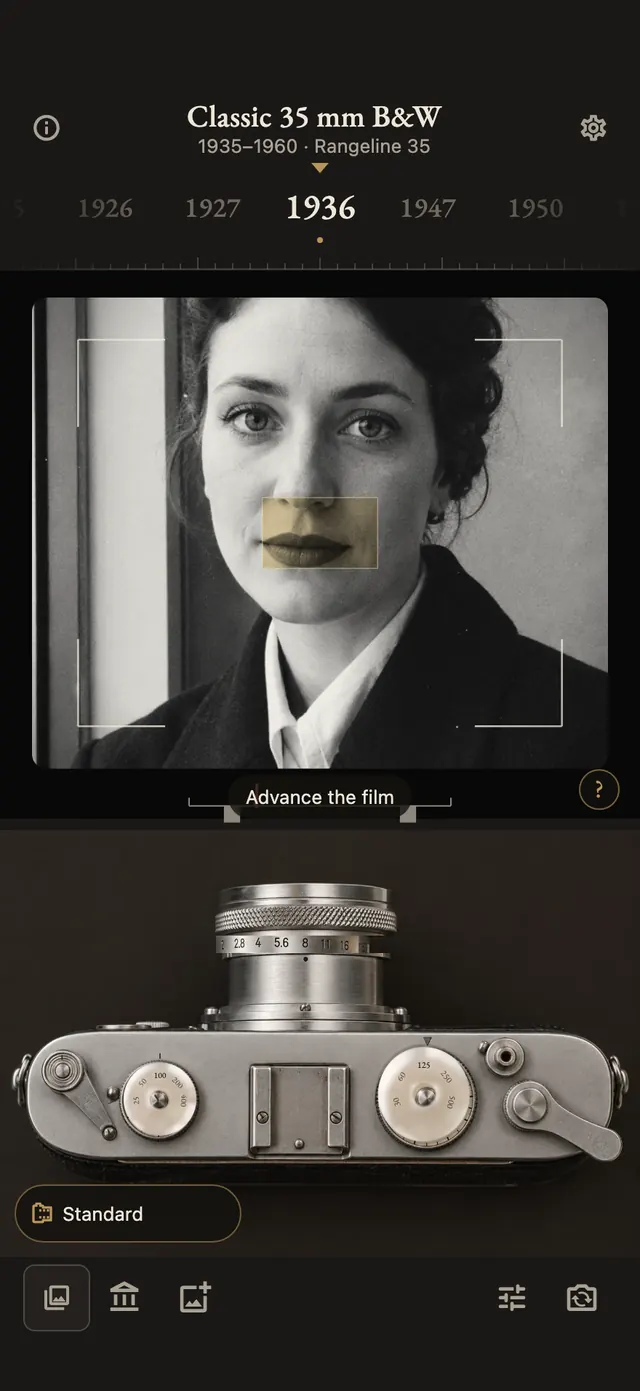
- 1936 Classic 35 mm B&WFree Panchromatic 35 mm film
- 1947 Press camera Film pack and flash bulbs
- 1950 Early colour slide Colour reversal film
- 1952 Twin-lens reflex 120 roll film, 6 × 6 cm
- 1963 Half-frame 35 mm film, half-size frames
- 1968 Square cartridge 126 cartridge film, square frame
- 1972 Instant film Integral instant print
- 1975 SLR 35 mm film, through-the-lens viewing
- 1976 110 pocket 110 cartridge film
- 1982 Plastic toy camera 120 roll film in a plastic body
- 1992 Four-lens camera 35 mm film, four lenses in sequence
- 1994 DisposableFree ISO 800 film in a plastic box
- 1995 35 mm compact Consumer colour negative, date back
- 1996 Panoramic compact 35 mm film with a panorama mask
- 1998 APS compact APS cartridge, three print formats
- 2003 CCD digicam Small CCD sensor, compressed JPEG
- 2004 VGA camera phone 640 × 480 phone sensor
- 2005 Early DSLR 6 to 8 megapixel APS-C sensor
- 2006 Webcam USB camera, 320 × 240 to 640 × 480
- 2010 Early phone square Phone sensor and a square filter
More than filters
Operate the camera.
Get its picture.
Old cameras are worked the way they were. Slide in the plate, lift the cap and count the seconds; crank the film by hand; wait for an instant print to develop. Prefer one tap? Quick shoot in Settings does the plate, cap and winding for you.
- Plate cameras show the dim ground glass upside down and reversed, as it really was
- The 1925 camera films as you turn the crank, with title cards and a piano rag
- The 1898 stereo camera makes a stereo card and a small animation that shows the depth
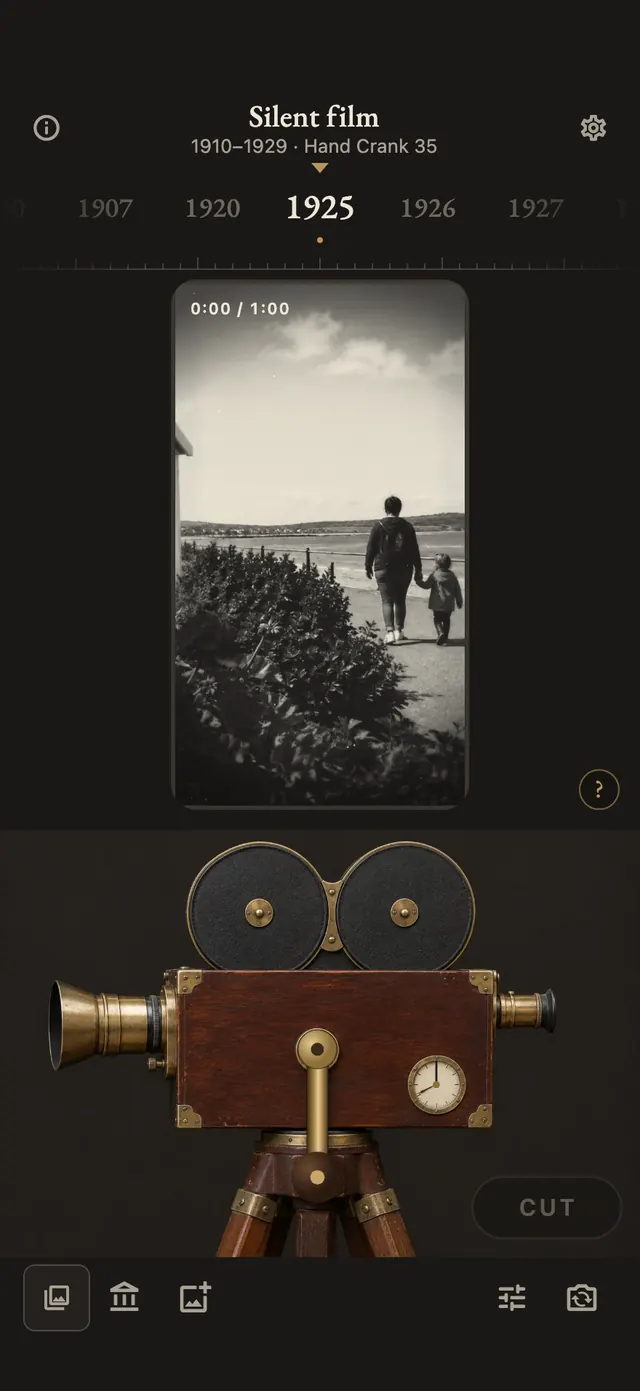
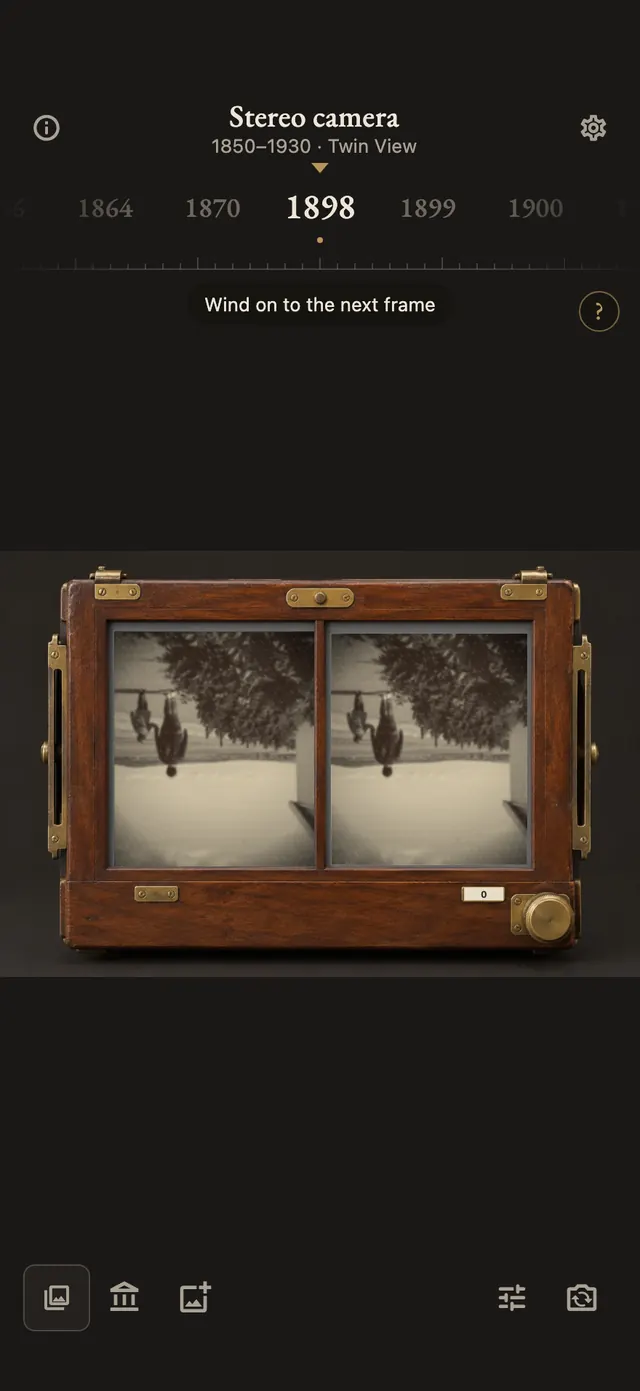
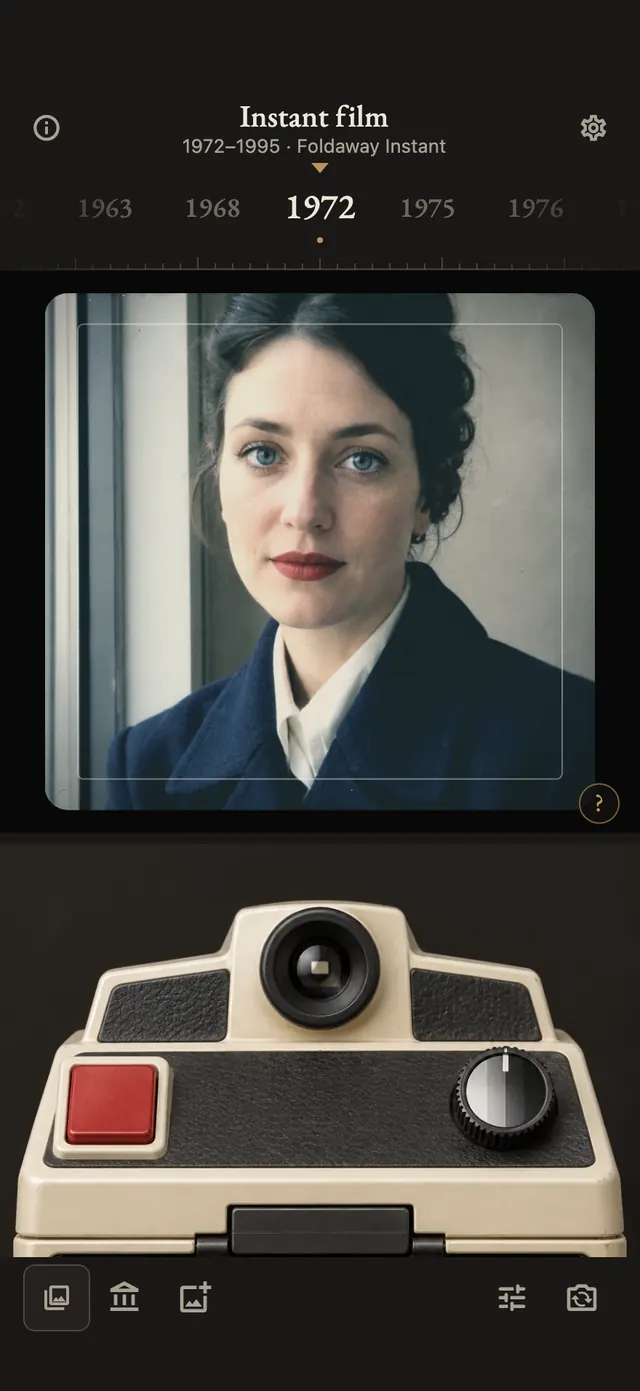
Real app footage
-
Tintype, 1856 Slide in the plate, lift the cap, count, and the plate appears. -
Silent film, 1925 Turn the crank, add a title card, and the film is developed. -
Instant film, 1972 The print develops on screen in about a minute.
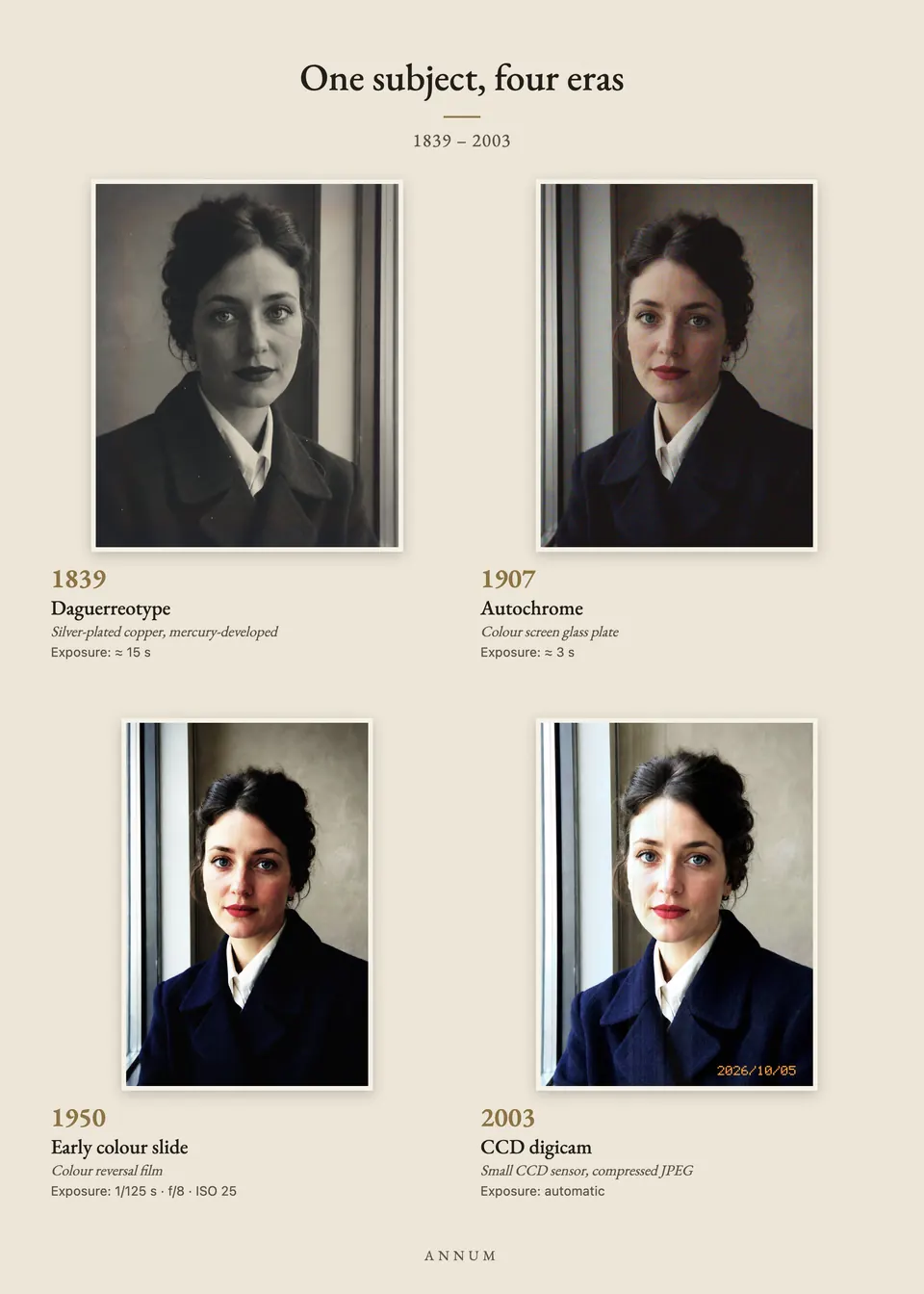
One photo, four eras
The same picture, developed four ways
Annum puts one photo on a single sheet as an 1839 daguerreotype, a 1907 colour plate, a 1950 slide and a 2003 digicam file. Save it as an image or a one-page PDF; Pro lets you choose the eras.

Features
Inside the app
The lab: tintype, 1856
A wet-plate session in six steps: prepare the plate, judge the light, lift the cap, count. Your exposure is graded against the light the scene really had.
Load a film or a plate
Black and white from 100 to 3200, everyday and fast colour, slide, tungsten, expired film, infrared. Plate cameras take wet collodion, dry, orthochromatic or panchromatic plates.
A look that is historically right
Collodion saw almost only blue light, so red lips turn dark and blue eyes go pale. Annum models light sensitivity, lens, grain, paper and the damage of time, era by era, then frames the print in the mount of its day.
Missions, album and darkroom
Missions set small photographic tasks, and some unlock a camera you keep. The album sorts pictures by roll and by camera. An optional darkroom lets you develop black-and-white prints yourself.
Your own photos, any era
Pick any photo from your library and develop it through the camera in your hand. Annum saves a new photo; the original is never changed.
Fair and private
Three cameras free forever. Annum Pro: yearly with a 7-day free trial, or a one-time lifetime purchase. No ads, no credits, no weekly plans, no account, no tracking.
Shot on Annum
#ShotOnAnnum
Made with Annum? Share your creation with #ShotOnAnnum. We may feature selected works with the creator’s permission.
How featuring worksExamples made with Annum
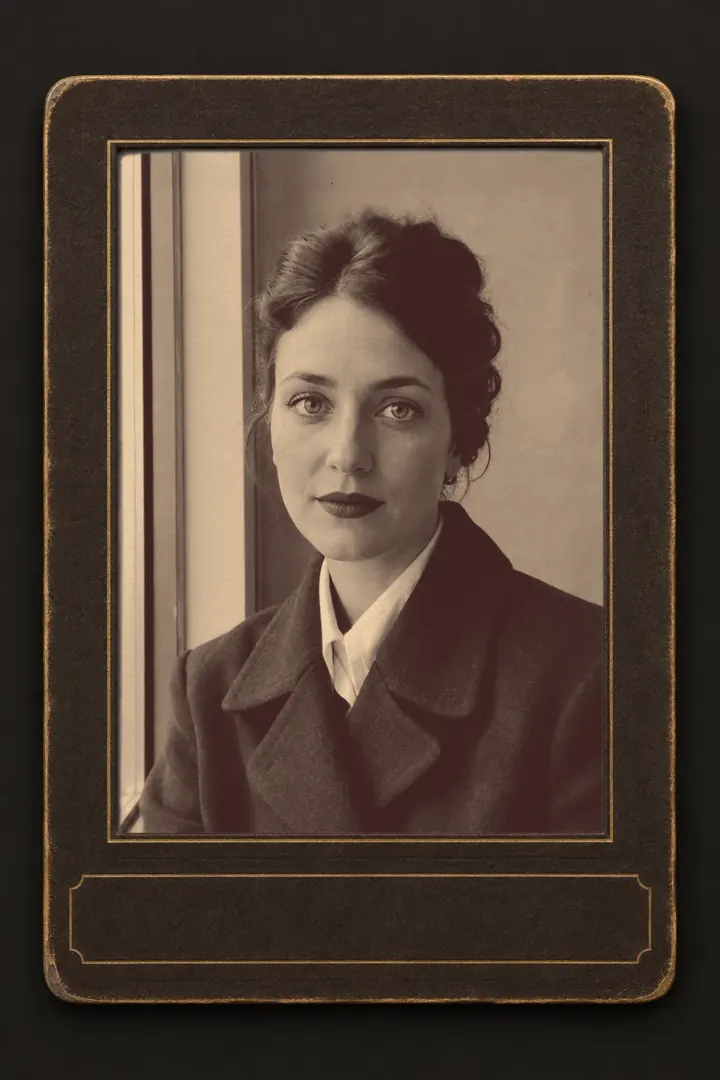
Albumen cabinet card · 1870 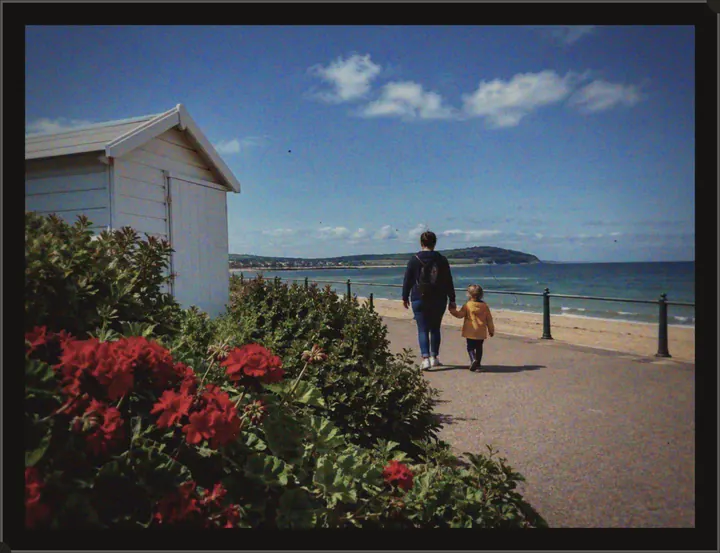
Autochrome · 1907 
Disposable · 1994 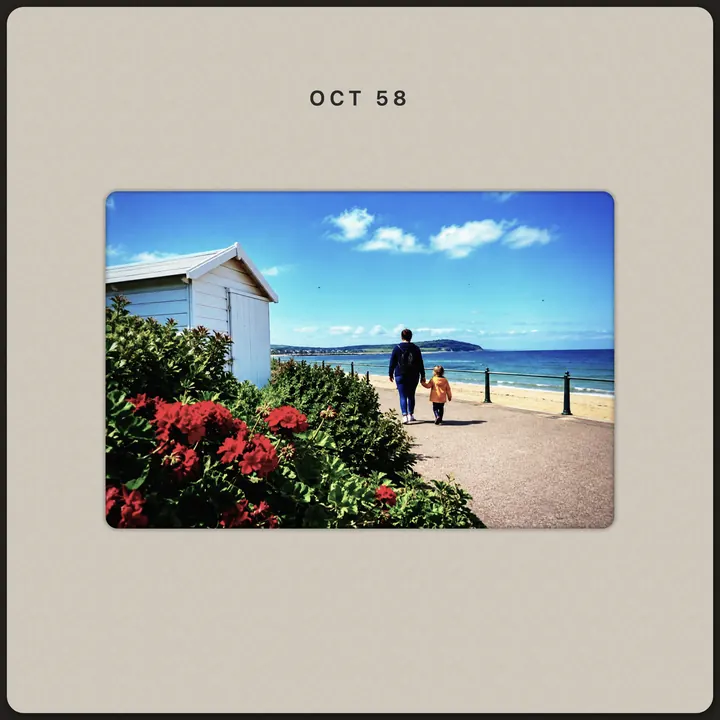
Early colour slide · 1950 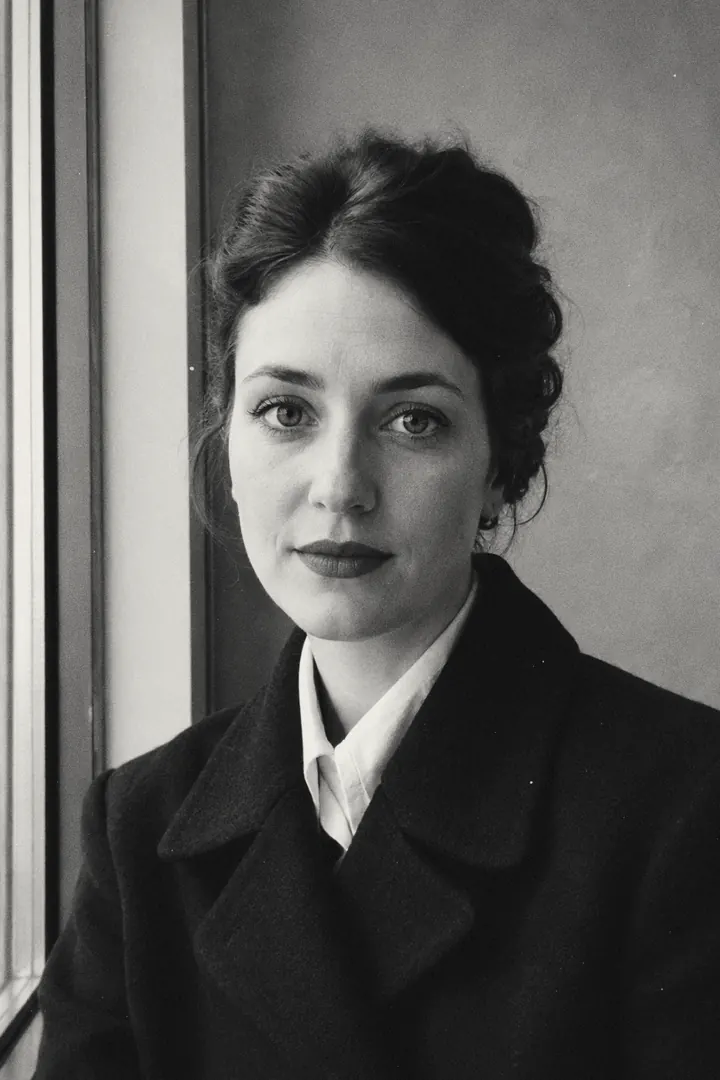
Classic 35 mm B&W · 1936 -
Stereo camera · 1898
The demo photos are AI-generated; every plate, print and file on this page was developed in Annum.
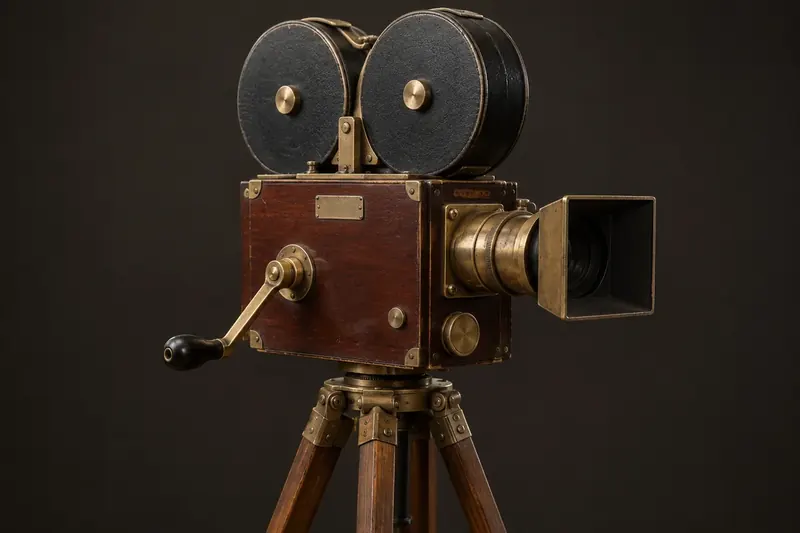
The history of photography,
yours to make
Annum for iPhone
Coming soon to the App Store